

riddle
Name
• Scientific name: Tectona grandis L. F.
• Spanish name: Teka
Origin
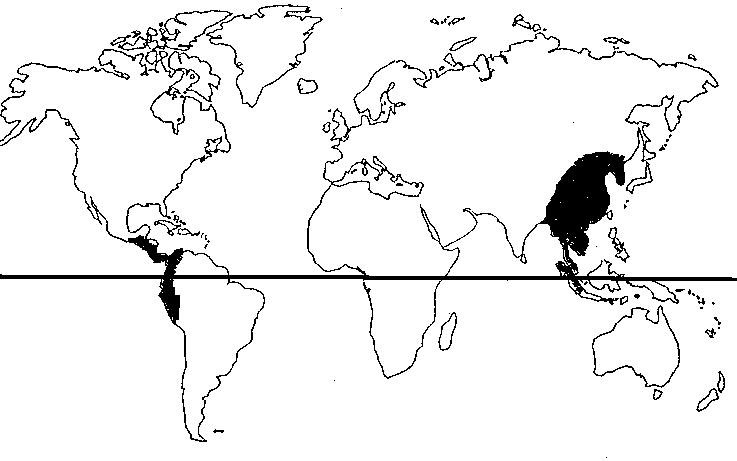
Description of the wood
• Sapwood: Yellowish-white to grayish.
• Heartwood: Yellowish-brown to dark brown with frequent dark gray streaks.
• Grain: Straight.
• Texture: Medium to coarse.
• Defects: Oily wood with calcareous and silica deposits.
Impregnation
• Sapwood: Poorly permeable
• Heartwood: Not permeable
Mechanization
• Sawing: No major problems other than its high silica content, which quickly wears down tools and causes allergies in workers.
• Drying: Slow to very slow drying rate. Minor risk of warping and cracking.
• Planing: No major problems other than its abrasiveness. Suitable for bending.
• Gluing: High difficulty due to its high oleoresin content, especially when using alkaline glues.
• Nailing and screwing: Requires pre-drilling.
• Finishing: The same difficulties as mentioned for gluing.
Applications
• Fine interior and, especially, exterior furniture and joinery. Bent and turned furniture.
• Interior and, especially, exterior carpentry; doors, windows, flooring, and paneling.
• Shipbuilding.
• Decorative veneers.
Mechanical properties
• Static bending strength: 1,020 kg/cm²
• Modulus of elasticity: 110,000 kg/cm²
• Compressive strength parallel to the axis: 630 kg/cm²
To be considered
The photos are of Asian teak.
In some African and South American countries, there are plantations of trees of this species. Because it is fast-growing, with widely spaced growth rings, its characteristics and performance are inferior; it has less fat, so its resistance to the elements is lower, and it has wide, dark fronds.